
Research, UXUI, Product, Brand
2025
ALIO
A multimodal system that helps people reposition themselves in relation to problems, values, and meaning.
Designing for Conscious Agency
ALIO is a speculative research-through-design project that examines how interactive systems can support people during moments when problem-saturated stories restrict agency. It integrates narrative therapy principles with embodied interaction to help users externalize dominant stories, and reclaim a sense of identity and agency.
Role
UX research · Concept lead · Interaction design · Systems thinking
FOCUS
AI-mediated narrative therapeutics · Cognitive neuroscience · Affective computing · Multimodal interfaces
ALIGNMENT
MIT Media Lab — Cyborg Psychology · Fluid Interfaces · Critical Matter
Output
Conceptual system architecture · High-fidelity interaction flows · Affective artifacts family · Narrative case study
“How can multimodal, AI-mediated systems support narrative externalization, embodied regulation, and meta-awareness to support mental health and emotional resilience?”
observation
The Human Problem
This project did not start from “let’s build a mental health app.”
It started from a deeper observation: people do not suffer only because of their emotions. They suffer because they get trapped inside problem-saturated stories about themselves.
The Human Problem as Understood Through Narrative Therapy
People often become recruited into problem-saturated stories—interpretations shaped by cultural discourses, relationships, and past events. Over time, these stories can become internalized, forming limiting identity conclusions such as “this problem defines who I am” or “this is the only way things can be.”
Narrative therapy views this as a thin description: a single storyline that becomes dominant and restricts access to preferred intentions, values, and possibilities. When a thin description takes hold, it narrows the person’s sense of agency and makes alternative narratives difficult to perceive.
Re-authoring begins when the person can separate themselves from the problem, notice unique outcomes, and thicken alternative stories that reflect their skills, commitments, and hopes.
The Cognitive Science Layer
From a cognitive perspective, self-referential narratives are supported by the Default Mode Network (DMN). Under stress, the DMN tends to rehearse negative storylines, reinforcing the dominance of problem-focused interpretations. The salience and control networks regulate shifts of attention; when this regulation is weak, attention becomes stuck on internal narratives, making them feel inevitable.
ALIO sits at the intersection of these two domains:discursive meaning-making (narrative therapy) and neurocognitive dynamics (DMN–salience–control).
INSIGHT
Agency begins to return the moment a person can see themselves outside the problem. Narrative therapy calls this repositioning.
ALIO’s design objective is to make that repositioning accessible, embodied, and repeatable through multimodal interaction.
Research questions
Which combinations of bio-signals (HRV, EDA, temperature, muscle tension) and interaction modalities (pressure, warmth, texture change, subtle motion) are most effective for down-regulating anxiety or up-regulating energy?
How can AI models learn individualized “co-regulation profiles” that remain interpretable and allow the user to maintain agency over interventions?
How do such wearables shift people’s subjective sense of embodiment, emotional self-efficacy, and dependence on technology?
Research Foundations
The three main bodies of work, which together shaped the system logic.
A narrative transformation sequence mapped to somatic, cognitive, and relational cues.
Narrative Therapy
Problems are located in stories, not people. Externalization—naming the problem as separate from "me"—restores agency. The goal is to thicken preferred stories aligned with values.
Large-Scale Brain Networks (LSBNs)
Focus on large-scale networks: DMN (autobiographical), Salience (tagging importance), and Control. Understanding how people get stuck in maladaptive network configurations like rumination.
HCI/Affective Computing
Embodied cues interrupt cognitive rumination. Somatic signal interpretation, micro-cue modulation, embodied interruption, HCI/Interaction design, artifact-based cognition, computational scaffolding, agency-centered design.
System Overview
ALIO operates as an ecosystem of four distinct but interconnected modules. Each module targets a specific phase of the narrative reconstruction process, from initial externalization to embodied integration. By distributing the therapeutic process across digital sense-making and physical grounding, the system creates a continuous support loop.
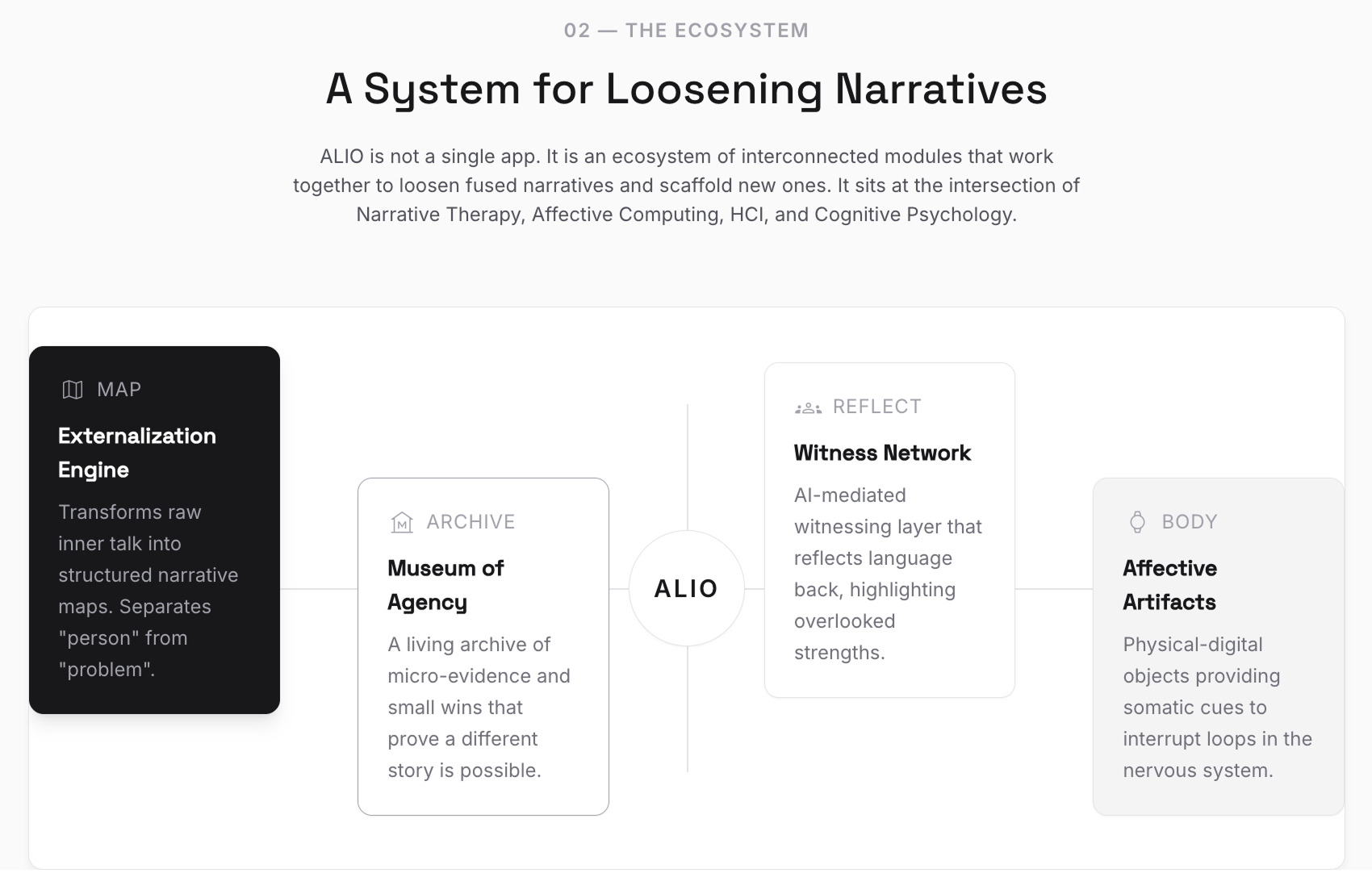
Externalization Engine
LLM-driven analysis that parses spoken narratives into nodes of influence, values, and effects.
Museum of Agency
A spatial archive where preferred storylines are curated, visualized, and revisited.
Witness Network
An anonymous, peer-to-peer validation layer where users can 'witness' others' preferred stories.
Affective Artifact Layer
Physical interfaces that provide haptic feedback and somatic anchoring for new narratives.
06
Design Principles
Externalization over introspection
Shift meaning‑making into a relational, object‑mediated space.
Thickening preferred stories
Provide structures that help expand alternative narratives.
Embodied regulation
Use somatic interventions to support cognitive flexibility.
Agency
Design for repositioning, not correction.

Research, UXUI, Product, Brand
2025
ALIO
A multimodal system that helps people reposition themselves in relation to problems, values, and meaning.
Designing for Conscious Agency
ALIO is a speculative research-through-design project that examines how interactive systems can support people during moments when problem-saturated stories restrict agency. It integrates narrative therapy principles with embodied interaction to help users externalize dominant stories, and reclaim a sense of identity and agency.
Role
UX research · Concept lead · Interaction design · Systems thinking
FOCUS
AI-mediated narrative therapeutics · Cognitive neuroscience · Affective computing · Multimodal interfaces
ALIGNMENT
MIT Media Lab — Cyborg Psychology · Fluid Interfaces · Critical Matter
Output
Conceptual system architecture · High-fidelity interaction flows · Affective artifacts family · Narrative case study
“How can multimodal, AI-mediated systems support narrative externalization, embodied regulation, and meta-awareness to support mental health and emotional resilience?”
observation
The Human Problem
This project did not start from “let’s build a mental health app.”
It started from a deeper observation: people do not suffer only because of their emotions. They suffer because they get trapped inside problem-saturated stories about themselves.
The Human Problem as Understood Through Narrative Therapy
People often become recruited into problem-saturated stories—interpretations shaped by cultural discourses, relationships, and past events. Over time, these stories can become internalized, forming limiting identity conclusions such as “this problem defines who I am” or “this is the only way things can be.”
Narrative therapy views this as a thin description: a single storyline that becomes dominant and restricts access to preferred intentions, values, and possibilities. When a thin description takes hold, it narrows the person’s sense of agency and makes alternative narratives difficult to perceive.
Re-authoring begins when the person can separate themselves from the problem, notice unique outcomes, and thicken alternative stories that reflect their skills, commitments, and hopes.
The Cognitive Science Layer
From a cognitive perspective, self-referential narratives are supported by the Default Mode Network (DMN). Under stress, the DMN tends to rehearse negative storylines, reinforcing the dominance of problem-focused interpretations. The salience and control networks regulate shifts of attention; when this regulation is weak, attention becomes stuck on internal narratives, making them feel inevitable.
ALIO sits at the intersection of these two domains:discursive meaning-making (narrative therapy) and neurocognitive dynamics (DMN–salience–control).
INSIGHT
Agency begins to return the moment a person can see themselves outside the problem. Narrative therapy calls this repositioning.
ALIO’s design objective is to make that repositioning accessible, embodied, and repeatable through multimodal interaction.
Research questions
Which combinations of bio-signals (HRV, EDA, temperature, muscle tension) and interaction modalities (pressure, warmth, texture change, subtle motion) are most effective for down-regulating anxiety or up-regulating energy?
How can AI models learn individualized “co-regulation profiles” that remain interpretable and allow the user to maintain agency over interventions?
How do such wearables shift people’s subjective sense of embodiment, emotional self-efficacy, and dependence on technology?
Research Foundations
The three main bodies of work, which together shaped the system logic.
A narrative transformation sequence mapped to somatic, cognitive, and relational cues.
Narrative Therapy
Problems are located in stories, not people. Externalization—naming the problem as separate from "me"—restores agency. The goal is to thicken preferred stories aligned with values.
Large-Scale Brain Networks (LSBNs)
Focus on large-scale networks: DMN (autobiographical), Salience (tagging importance), and Control. Understanding how people get stuck in maladaptive network configurations like rumination.
HCI/Affective Computing
Embodied cues interrupt cognitive rumination. Somatic signal interpretation, micro-cue modulation, embodied interruption, HCI/Interaction design, artifact-based cognition, computational scaffolding, agency-centered design.
System Overview
ALIO operates as an ecosystem of four distinct but interconnected modules. Each module targets a specific phase of the narrative reconstruction process, from initial externalization to embodied integration. By distributing the therapeutic process across digital sense-making and physical grounding, the system creates a continuous support loop.
Externalization Engine
LLM-driven analysis that parses spoken narratives into nodes of influence, values, and effects.
Museum of Agency
A spatial archive where preferred storylines are curated, visualized, and revisited.
Witness Network
An anonymous, peer-to-peer validation layer where users can 'witness' others' preferred stories.
Affective Artifact Layer
Physical interfaces that provide haptic feedback and somatic anchoring for new narratives.
06
Design Principles
Externalization over introspection
Shift meaning‑making into a relational, object‑mediated space.
Thickening preferred stories
Provide structures that help expand alternative narratives.
Embodied regulation
Use somatic interventions to support cognitive flexibility.
Agency
Design for repositioning, not correction.